DALE
Conversational commerce agent with Gemini native tools & BGE retrieval
DALE is an autonomous conversational shopping agent built for the PayPal AI Hackathon that bridges Gemini native function calling with a production-grade multi-category storefront. The agent navigates catalog hierarchies, compares technical specifications, orchestrates cart operations, controls separate browser tabs, and manages persistent group sessions. Built as a Next.js modular monolith with React 19, Motion, GSAP, and PostgreSQL, DALE pairs lexical identity matching with local BGE semantic embeddings, ensuring conversation memory and committed transactional effects survive browser refreshes.
An effective conversational agent cannot live in an isolated chat bubble; it must directly orchestrate the actual application domain services with validated state transitions and visible customer approval gates.
Targeted Contracts
155
distinct contracts across 29 recorded browser journeys
Flash Camera Regression
2 / 2
live customer requests passed with strict parameter adherence
Architecture
Monolith
Next.js 16, React 19, PostgreSQL & PGlite local previews

The page keeps the strongest metrics and the strongest caveats in the same frame. Numbers are included because they clarify the system, not because they decorate it.
Retrieval Model
Hybrid
lexical identity lookup + local BGE semantic vector retrieval
Session State
Durable
conversation history, cart mutations, and browser receipts survive refresh
Safety Model
Approval Gate
sensitive returns, cancellations, and checkout require customer confirmation
Repository
Next.js monolith, concierge server, and Playwright suites
README
capabilities matrix, system architecture, and validation ledgers
Architecture Record
agent loop, function calling schema, and persistence design
Validation Ledger
qualification ledger, camera regression case study, and timing notes
The project is explained across seven recurring dimensions so the reader can understand not only what was built, but why the implementation matters, where the proof is strongest, and where the limits still are.
Case-study dimension
Why This Exists
Most e-commerce chatbots are isolated widgets that recite FAQ text and lack direct execution authority over the store. When customers ask complex cross-product questions or demand action, these bots fail.
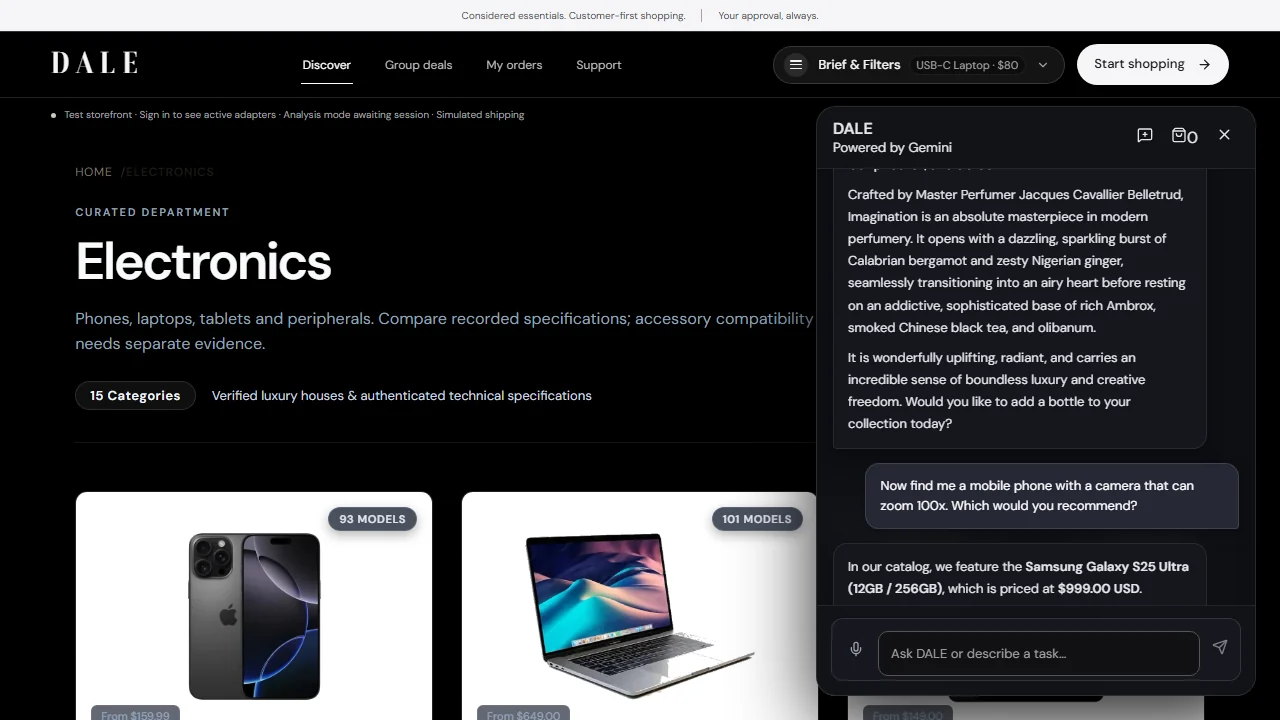
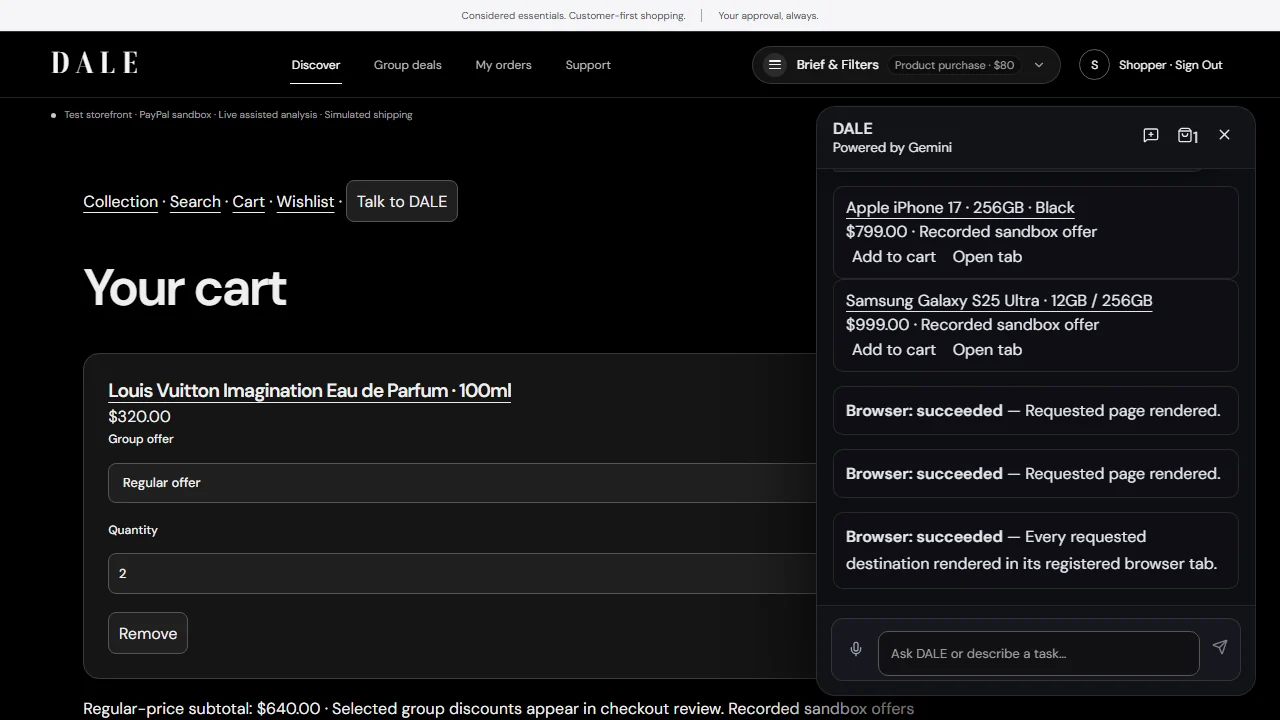
DALE was designed to demonstrate conversational agency: an agent that can compare product specifications, open comparison tabs, update cart quantities, and guide checkout directly inside the application runtime.
Case-study dimension
Why It Matters Now
With the arrival of native function calling and multimodal foundation models, the primary challenge in AI engineering has shifted from basic text generation to tool orchestration reliability and state consistency.
DALE proves how conversational agents can safely interact with complex consumer interfaces when bound to strict type-checked service contracts and explicit human-in-the-loop approvals.
Case-study dimension
What It Improves
Rather than relying on brittle HTML scraping, DALE binds Gemini directly to native TypeScript application services, ensuring schema validation on every tool call before execution.
A hybrid retrieval pipeline pairs exact lexical identity matching with local BGE semantic embeddings, allowing the agent to answer nuanced questions while preventing product hallucination.
Case-study dimension
What Makes It Different
The system supports persistent group commerce across independent customer sessions, allowing multiple users to co-shop in real time.
All conversation logs, tab states, and transaction receipts are durable across page reloads, backed by PostgreSQL persistence and local PGlite instances for isolated testing.
Case-study dimension
Why It Is Hard To Replicate
Synchronizing asynchronous LLM streaming with optimistic React 19 UI state and GSAP animation transitions without UI jitter requires rigorous frontend architecture.
Enforcing strict negative constraints—such as refusing to substitute digital zoom when optical zoom is requested—demands disciplined prompt grounding and structured retrieval boundaries.
Case-study dimension
How It Can Grow
Expanding to multi-agent negotiation where supplier agents submit dynamic merchant offers directly to the customer's conversational session.
Integrating direct PayPal vault tokenization for autonomous one-click checkout within pre-authorized spend limits.
Case-study dimension
Why It Lasts
The core pattern—natural language intent mapped to validated domain commands with persistent receipts—is the enduring paradigm for AI-driven software interfaces.
As conversational models become faster and more commoditized, the value remains in the integration fabric, domain contracts, and deterministic safety boundaries.
Action Lifecycle
From customer intent to validated domain effects with receipt verification
Every user request flows through a four-stage execution lifecycle: customer intent extraction, catalog fact resolution via BGE embeddings, validated schema execution, and observed browser receipts.
Sensitive operations—such as final payment confirmation or dispute initiation—pause the agent loop for explicit customer approval before committing state.

Architecture
Modular Next.js monolith with hybrid BGE retrieval and durable state
The system pairs Next.js 16 App Router with a durable server agent loop. Catalog facts are indexed in PostgreSQL with pgvector and local BGE embeddings for millisecond retrieval.
The copilot bridge coordinates browser events, voice microphone input with local transcription, and tab management without losing conversation context.

Next case
Blob-Cloud